Huntsville Drainage Solutions for Wet Lawns, Hillside Runoff, and Roof Water
Living in Huntsville means your yard may have to handle more than the rain falling directly on it. Water can arrive from higher ground, pour off the roof, follow the edge of a driveway, or move through saturated soil before you ever see it. On a South Huntsville property near Bailey Cove Road, the backyard grade may play a major role. In Five Points, the bigger challenge may be fitting drainage into a narrow, established lot where houses, walks, alleys, and neighboring properties leave less room to work.
That’s why Crawl Space Ninja doesn’t begin with the assumption that every wet yard needs the same drain. We provide yard drainage, French drain pipe, sump pumps, and downspout extensions, choosing the solution based on how water behaves at your Huntsville property. Contact us online to schedule an evaluation and find out what it will take to get water under control.

One Property, Several Ways for Water to Get In
Before we talk about individual drainage services, it helps to separate the different kinds of water we’re dealing with. The water running across your grass during a storm isn’t necessarily the same problem as the ground that stays saturated three days later. Roof runoff adds another source, and the elevation of the property determines whether collected water can leave naturally.
You can see why this matters around Huntsville. Near Monte Sano, a property can have a pronounced downhill route for runoff. Move into Old Town or Five Points and the lot becomes tighter, with existing sidewalks, driveways, landscaping, and neighboring homes affecting our options. Farther south around Mountain Gap and Green Mountain, elevation becomes a major part of the conversation again. We account for those differences before deciding what belongs underground.
Yard Drainage That Works With the Lay of Your Land
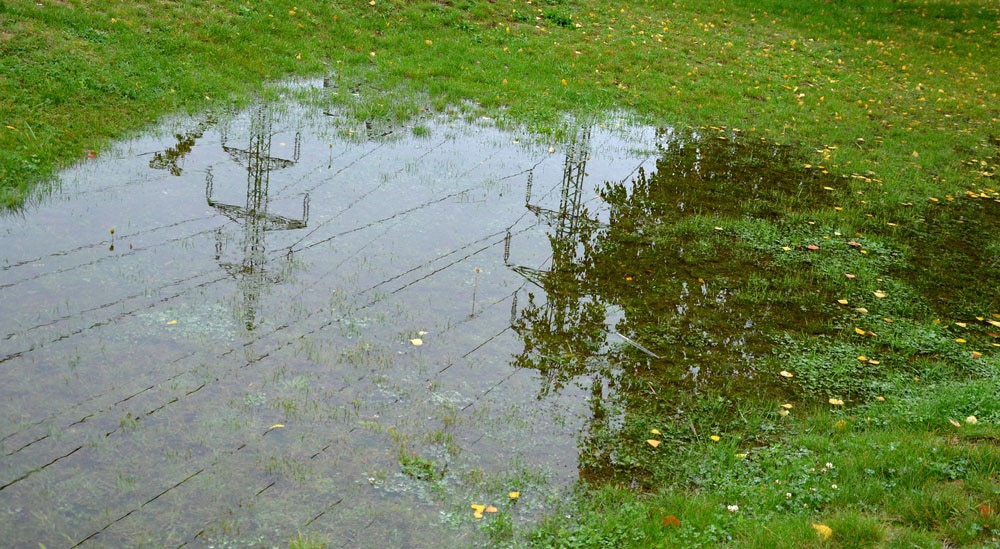
If you can watch water travel across the lawn while it’s raining, we’re dealing with a surface-water problem. Maybe it follows the same track beside the driveway every time. Perhaps runoff comes down from the back of the lot and spreads across the patio. You might simply have a low section that becomes a temporary pond after a summer storm.
Those situations can call for yard drainage designed to intercept water before it reaches the trouble spot. Common signs include:
- Puddles that consistently form in the same section of lawn
- Runoff crossing patios, walks, or driveways
- Soil or landscaping washing downhill
- Water flowing toward the house
- Grass that remains soggy in obvious low areas
Huntsville’s topography makes it important to see the whole yard. Around Monte Sano and Green Mountain, the uphill source may be well beyond the place where water finally collects. In Jones Valley, the surrounding hills and residential grades can influence the route across a property. Even around Airport Road, Whitesburg Drive, and Bailey Cove, the elevation can change enough from one lot to the next that we don’t want to design drainage from the curb.
We walk the grade and determine where surface water can be intercepted without simply sending the problem farther downhill.
French Drain Pipe for the Yard That Stays Soft
Here’s a different problem. It rained Tuesday. By Friday, most of the yard is ready to mow, but one strip along the house is still soft enough to leave footprints.
There may not be any obvious runoff to catch. Water can move through the soil and collect where the ground, slope, or surrounding conditions allow it to remain. French drain pipe gives that subsurface moisture a path to follow.
We start thinking about a French drain when we find conditions such as:
- A side yard that remains saturated between storms
- Soft ground along the bottom of a slope
- Moisture moving through soil from higher ground
- Repeatedly wet areas beside the house
- Saturation that surface drains alone won’t correct
This can look quite different depending on where we’re working. A backyard climbing toward Green Mountain may receive subsurface water from uphill. In Five Points, the historic pattern of narrow, deep lots and rear alleys can create a much tighter drainage corridor. Around Old Town, established walks, driveways, landscaping, and neighboring properties may further influence where pipe can run.
We don’t put French drain pipe in the yard simply because that’s where the grass looks wettest. We determine where the water is traveling below the surface and position the system where it can actually collect it.
Downspout Extensions Start the Fix at the Roof
Sometimes the yard isn’t creating the water problem at all. Look up. Your gutter system takes rain falling across the roof and concentrates it into a handful of outlets. If a downspout ends two feet from the foundation, one small section of yard may be receiving runoff from hundreds of square feet of roof.
There are several clues that tell us the gutter discharge deserves attention:
- A washed-out pocket directly below the downspout
- Mulch scattered away from the house after storms
- Soil staying wet around one corner of the foundation
- Gutter water crossing a walkway or driveway
- Multiple downspouts emptying toward the same low area
Where we send that water depends on the Huntsville lot. On a property near Mountain Gap Road, releasing roof water on the uphill side can add to runoff already heading down the grade. Along Pratt Avenue or California Street in Five Points, the issue may be finding enough room to move water without sending it toward a neighboring home or rear alley.
A downspout extension needs a useful destination. Adding pipe without thinking about the endpoint can turn one wet area into another.
Sump Pumps Give Trapped Water a Way Out
A sloped yard doesn’t always mean drainage is easy. Sometimes the part of the property that collects water sits in a pocket with higher ground between it and the available outlet. You can install pipe to collect the water, but gravity still has to be able to move it.
When the elevations don’t cooperate, a sump pump may become part of the system. We consider mechanical drainage when the property presents problems like:
- A backyard sitting below the street
- A low area surrounded by higher elevations
- Collected drainage water with no downhill outlet
- French drain pipe terminating below the discharge location
- Water trapped where gravity can’t carry it away
South Huntsville gives us plenty of examples of why elevation matters. Around Mountain Gap, Green Mountain Road, and portions of Bailey Cove, a backyard and front yard can sit at noticeably different elevations. A pump can collect water at the lower point and move it toward a suitable discharge location when buried drainage pipe can’t accomplish that on its own.
We still check for a gravity option first. A sump pump is useful when the property needs one, but there’s no reason to make a drainage system more complicated than necessary.
Choosing the Right Drainage Setup for Your Huntsville Home
What you see after a storm gives us a starting point. A stream running across the lawn points us toward surface drainage. Ground that stays soft well after the storm suggests we need to look below the surface. Washed-out mulch beneath a gutter tells us to inspect the roof runoff, while a low backyard with nowhere downhill to drain raises a completely different question.
Those conditions change as you move through Huntsville. The narrow lots and rear alleys around Five Points don’t give us the same options as a hillside property near Monte Sano. Jones Valley brings its own surrounding terrain, while Bailey Cove, Mountain Gap, and Green Mountain can put elevation front and center. Your drainage system needs to fit the lot you’re standing on.
Crawl Space Ninja installs yard drainage, French drain pipe, sump pumps, and downspout extensions for Huntsville homeowners who are ready to stop working around wet areas every time it rains. Contact us online to schedule an evaluation and let us determine what is keeping water on your property and what it will take to move it where it belongs.


Why Choose Our Services?
Crawl Space Ninja Eliminates the Guesswork.

Every decision we make on your job starts with one question: what's actually best for your home and your family.

We stand behind every job with our lifetime warranty, because giving you lasting protection and confidence in your investment.

Our technicians are trained and certified on the system we built and refined ourselves, not a one-size-fits-all fix.

From your first call to the final walkthrough, you’ll stay updated through every step of the process.

Consult, customize, commence. Every job starts with a plan built for your home, not a generic fix.

You'll know the full cost before work begins. No hidden fees, no surprises.
Find Your Closest Crawl Space Ninja!