Greenville Drainage Solutions for Wet Yards and Unwanted Runoff
A wet yard in Greenville can be deceiving. The puddle beside your house may be the last stop for water that started at the top of the backyard, followed the driveway, or came off the roof. On an established property around Augusta Road, landscaping and hardscaping can alter that route. Head north through Cherrydale toward Paris Mountain, and stronger grades can make downhill runoff much easier to spot.
Crawl Space Ninja provides yard drainage, French drain pipe, sump pumps, and downspout extensions for Greenville homeowners. From older neighborhoods around Overbrook to properties near Haywood Road, Patewood, Roper Mountain, and Verdae, we look at the grade, wet areas, roof runoff, and available outlets before deciding how to manage the water. Contact us online to schedule a drainage evaluation.
It Starts With Greenville’s High and Low Ground
You don’t need a steep hillside to have an elevation problem. A backyard can sit lower than the street, or a driveway and patio can interrupt the route water would otherwise take. Greenville’s rolling Piedmont terrain makes those smaller changes in grade important when we’re trying to figure out why the same part of your property stays wet.
We start by finding the high and low points and tracing how water travels between them. That’s useful whether we’re walking an established lot near Augusta Road, a property around West Faris Road, or a yard farther east near Verdae Boulevard. The solution comes after we understand the route.
Sump Pumps for Water Trapped at the Low Point
Sometimes the problem isn’t collecting the water. It’s getting that water out. If the wet area sits below the available discharge point, adding more buried pipe won’t make water travel uphill.
A pump starts becoming part of the conversation when we find:
- A backyard sitting below the street
- Water trapped between surrounding grades
- Drainage pipe without enough fall to reach an outlet
- A French drain collecting water below the discharge elevation
- A low area without a practical gravity route
Those elevation differences can show up around Roper Mountain Road and Verdae, where rolling ground can create noticeable changes across a residential lot. We can also encounter them south of downtown around Mills Avenue and West Faris Road. We check the elevations first, because if gravity gives us a reliable route, there’s no reason to add a pump.
Downspout Extensions for Concentrated Roof Water
If mulch or pine straw keeps washing out of the same bed, we usually look up before looking underground. Your gutters collect rain from a large roof area and concentrate it into a handful of downspouts. One poorly placed outlet can keep dumping water into a section of yard that’s already struggling to dry.
The gutter system deserves attention when you’re dealing with:
- Mulch or pine straw washing away below an outlet
- Soil eroding around one corner of the house
- Soft ground directly beneath a downspout
- Roof water crossing a sidewalk or driveway
- Multiple downspouts feeding the same low area
The Augusta Road area, or “The ’05,” gives us a good example of why the endpoint matters. Established homes, mature landscaping, driveways, patios, and neighboring properties can limit the available route. Over in newer areas around Verdae or Roper Mountain, we may have different options, but the grade still determines what happens after the water leaves the extension.
French Drain Pipe for Ground That Stays Wet
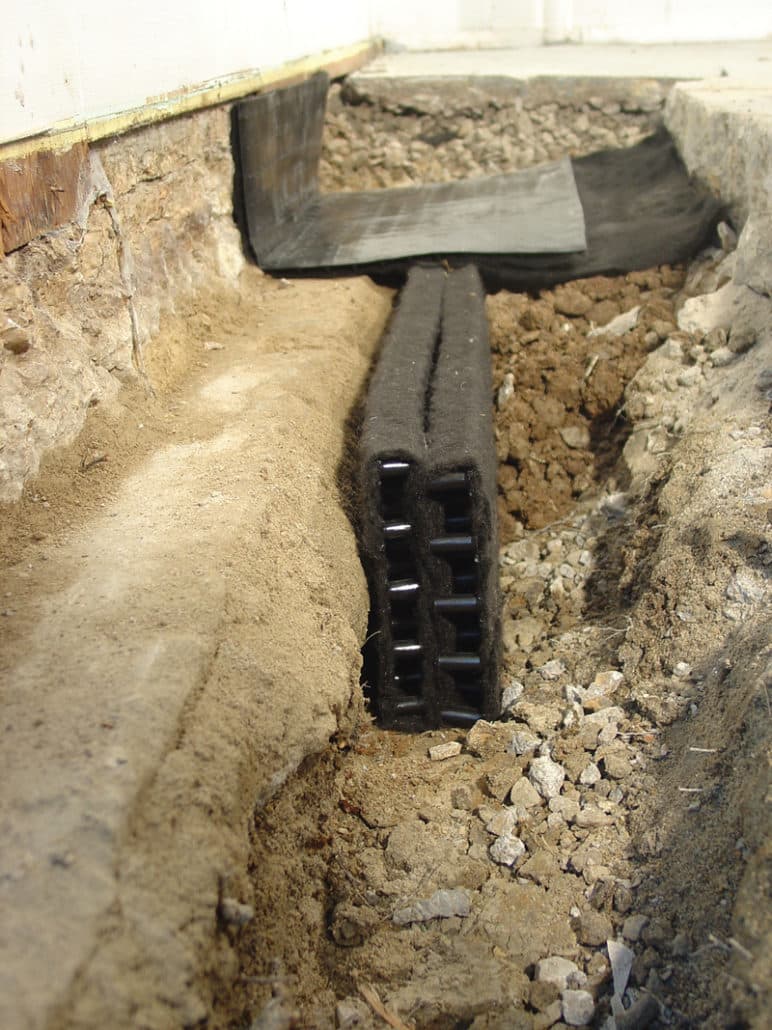
Sometimes the storm is long gone before the drainage problem becomes obvious. Most of your lawn may be dry enough to mow, while one strip along the house still feels soft under your shoes. That’s when we start looking at what’s happening below the surface.
When a Greenville yard refuses to dry, we’re checking for conditions such as:
- Saturated ground along the bottom of a slope
- Side yards that stay soft between storms
- Subsurface water coming from higher ground
- Wet soil without obvious surface runoff
- Areas that remain damp after the surrounding lawn dries
Greenville sits in the Piedmont, where clay-rich subsoils are common. Conditions vary from property to property, but that familiar Upstate clay can influence how water behaves once the ground becomes saturated. Around Overbrook, we may be working within a tighter established lot, while heading through Cherrydale toward Paris Mountain can bring stronger grades into the equation. French drain pipe needs to intercept the wet path, so we look beyond the softest patch to determine where the water is actually coming from.
Yard Drainage for Water Moving Downhill
Other properties show us the problem while the rain is still falling. Water may come down the backyard, follow the edge of the driveway, or cut through a landscape bed before settling near the house. Once you know where to look, the route can be surprisingly easy to see.
These are some of the signs that make us look closely at surface drainage:
- Runoff following the same path during storms
- Standing water returning to a low section
- Soil or mulch washing downhill
- Water crossing patios, walks, or driveways
- Rainwater consistently traveling toward the house
You don’t have to be on Paris Mountain to deal with runoff coming down a grade. Properties around Augusta Road, Cleveland Street, Haywood Road, and Patewood can all have their own elevation changes. Greenville’s City mapping even identifies separate drainage basins around West Faris Road, Overbrook, Patewood, Verdae Boulevard, and other parts of town. The larger Reedy River system may define Greenville’s landscape around Falls Park and Liberty Bridge, but on your property we’re focused on the smaller route between the top of your yard and the place where the water keeps collecting.
Drainage That Fits Your Greenville Property
A Greenville drainage problem can start at the roof, below the soil, or halfway up the backyard. You may have a low spot that can’t drain by gravity, a downspout feeding an already wet area, or runoff that gains speed as it travels downhill. That’s why we don’t decide what you need based solely on where the puddle appears.
Crawl Space Ninja provides sump pumps, downspout extensions, French drain pipe, and yard drainage for homeowners throughout Greenville. From established properties around Augusta Road and Overbrook to Cherrydale, Haywood Road, Patewood, Roper Mountain, and Verdae, we build the drainage plan around what the water is actually doing at your home. Contact us online to schedule a drainage evaluation.


Why Choose Our Services?
Crawl Space Ninja Eliminates the Guesswork.

Every decision we make on your job starts with one question: what's actually best for your home and your family.

We stand behind every job with our lifetime warranty, because giving you lasting protection and confidence in your investment.

Our technicians are trained and certified on the system we built and refined ourselves, not a one-size-fits-all fix.

From your first call to the final walkthrough, you’ll stay updated through every step of the process.

Consult, customize, commence. Every job starts with a plan built for your home, not a generic fix.

You'll know the full cost before work begins. No hidden fees, no surprises.
Find Your Closest Crawl Space Ninja!