What Does the EPA Say About Venting Sealed Crawl Spaces
What Does the EPA Say About Venting Sealed Crawl Spaces? Crawl space encapsulation can create issues if not properly ventilated per EPA guidelines. Local building codes vary on this issue but we want to share our thoughts on why you should ventilate a sealed crawl space. The goal of a sealed crawl space is to improve your indoor air quality. Not properly ventilating a sealed crawl space could create odors in your home and expose you to harmful soil gases.
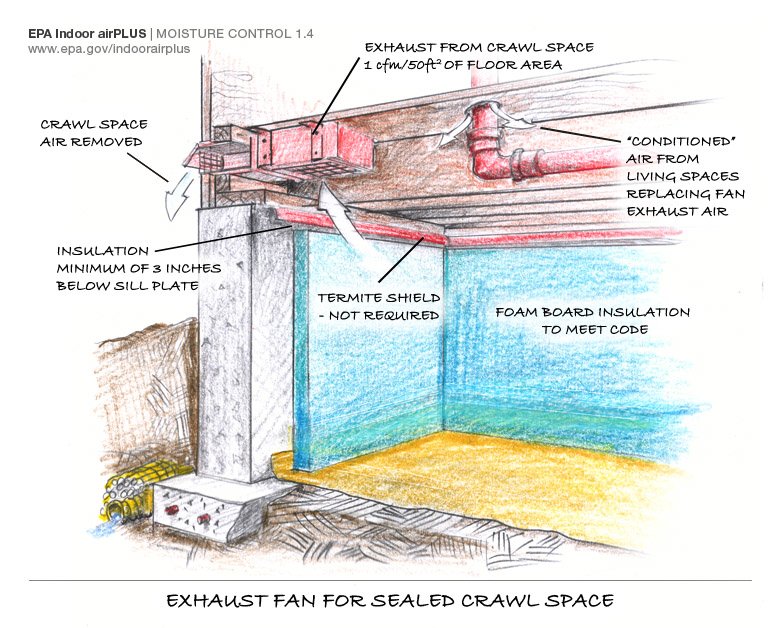
Exhaust 1 CFM for Every 50 SQ FT
The EPA (Environmental Protection Agency) recommendation for exhausting a sealed crawl space is based on the removal of soil gases before they can reach the living space. As you can see in the image provided by the EPA below, the crawl space contains vapor barrier, insulation, and ventilation. The image also shows the make-up air comes from the living space.
Does Code Require Venting a Sealed Crawl Space
We see codes vary from town to town. Some codes enforcement are against venting a sealed crawl space. While others encourage venting a sealed crawl space. You will need to check your local codes requirement in your area. Based on the EPA guidelines, I recommend you encourage the codes agency to allow ventilation of the encapsulated crawl space. Creating a soil gas issue while solving a humidity problem does not seem like a good trade off. Radon sub-membrane mitigation systems can also be installed versus a foundation vent fan to meet ventilation recommendations.
EPA Indoor AirPLUS Construction Guidelines
If you are looking for more information to help you decide if ventilating your crawl space after encapsulation makes sense. I encourage you to check out the EPA Indoor AirPLUS Construction Specifications.
Here is an excerpt:
1.4 Basement and Crawlspace Insulation and Conditioned Air
Indoor airPLUS Requirements:
- Seal crawl space and basement perimeter walls to prevent
outside air infiltration. - Insulate crawl space and basement perimeter walls according
to the prescriptive values determined by local code or R-5,
whichever is greater. - Provide conditioned air at a rate not less than 1 cfm per 50 sq.
ft. of horizontal floor area. This can be achieved by a dedicated
supply (2015 IRC section R408.3.2.2) or through crawl space
exhaust (2015 IRC section R408.3.2.1). However, if radon resistant features are required (see Specification 2.1), do not
use the crawl space exhaust method.
Ready to find out more?
Drop us a line today for a free quote!
What Next?
Do you need help with crawl space dehumidifiers or encapsulation in your home and you live in Georgia, Delaware, North Carolina, South Carolina, Tennessee, or Kentucky? If so, please contact us to schedule your assessment. Also, let us know in the comments below if you’d like to suggest a future blog post.
Perhaps you’d like to tackle your own crawl space repair. Visit our DIY Store.
Contact us if you need help fixing your crawl space or yard drainage by clicking here.
Learn about Crawl Space Ninja Franchise opportunities.