How to Fix Bouncing Floors
Bouncing floors are annoying. Hearing dishes clang together when I walk by a curio cabinet sends chills up my back. I may be weird but if I hear a rattle in my car, I have to stop and fix it.
Okay, maybe your sensitivity to annoying noises is not as bad as mine, but repairing bouncy floors can be a fairly simple process. I am going to share why your floors are bouncing, ways to correct it, steps to take before fixing it, and some things not to do.
Why Do My Floors Bounce
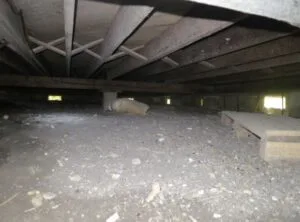
I have been in thousands of crawl spaces and seen from below what causes bouncing floors. Older homes suffer from bouncing floors more due to poor building practices, moisture problems, and mold.
Floor Joist Spacing
Floor joist sizes and spacing can allow floors to move over the years. Our current lifestyle causes us to have heavier appliances, more electronics, and much heavier flooring and cabinets. That kitchen remodel with the added island and new stainless steel appliances can put a heavy burden on your kitchen subfloor and sparsely placed inadequate joist system.
Lack of Pillars
Homes built today have way more pillars than homes built years ago. This addition of pillars and types of framing installed in crawl spaces and basements helps to secure the heavy loads we place on the flooring. If your home was built in the 60s, 70s, and 80s you most likely have one pillar every few hundred square feet. This lack of pillar support can contribute to bouncing floors.
Mold and Moisture
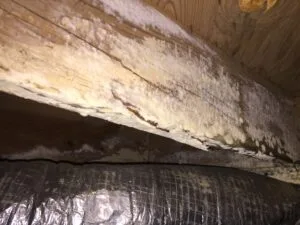
When your crawl space gets damp, then dries, then gets damp, a space can be created between the floor, subfloor, joists, and pillars. This is why having a conditioned space is so important. Once the wood gets wet, wood decay fungus can move in. Wood rot likes to eat the lignin, the skeletal system, of wood. This weakens the wood and creates more opportunities to bounce the floors.
What Not To Do When Fixing Floors
A big mistake many people do is attempting to fix the bouncing floors without correcting moisture and mold issues. I will be sharing ways to correct your floors, but if you don’t control humidity or flooding and do proper mold remediation, these ways may not work permanently.
Sure, it will appear to be corrected, but over time the problem will get worse, causing you to have to correct the bouncing floors again and again. I encourage you to check out our many articles and videos about mold remediation, crawl space encapsulation, and waterproofing.
Installing a Floor Bridge
Installing a floor bridge or X-brace is one of the simplest ways to address bouncing floors. If your flooring is covered in insulation, it may require a little more work. The insulation will need to be moved or removed, recut, and replaced around the floor bridge.
Due to the possible severity of floor problems, a floor bridge may not always fix all the bouncing. The wood in an “X” pattern is a floor bridge. You can also install premade metal floor bridges.
Composite Shims
Installing composite shims between joists and the subfloor could also help. Shims can also be placed between pillars and joists or I-beams and the subfloor. I like composite shims because they will not grow mold, are insect-proof, and are not affected by moisture.
They also tend to hold more weight than some shims. Metal shims can rust and wood shims can deteriorate over time.
Install Jack Posts and I-beams
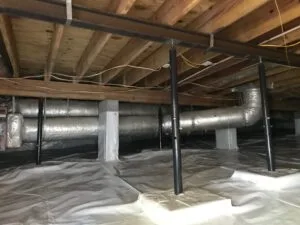
For extensive floor bouncing, jack posts and I-beams are great. Again, make sure you condition the space first. You can also use pressure-treated wood instead of I-beams. Jack posts, or post jacks, are placed on a secure foundation, like gravel and a cap block or poured footer, and can be adjusted to put pressure on the bouncing floor. You don’t want to over-adjust.
Just add enough pressure to give the support the flooring needs. Keeping the space conditioned will prevent the posts from rusting.
Sistering Joists
The final recommendation and may be one of the most difficult is sistering joists. This is done by adding a good joist next to a bad joist. Normally this is reserved for major issues in the subfloor. Many times a joist can break from too much weight or crack from termite and mold exposure.
When you see joists in the crawl space or basement cracked and broken, you may need to sister the joists plus install I-beams and post jacks.
Contact Crawl Space Ninja for Basement Waterproofing and Encapsulation
Please contact us to schedule your assessment to fix your crawl space, basement issue.
Do you need help with mold removal, crawl space encapsulation, crawl space insulation, vapor barrier, waterproofing, foundation repair, basement waterproofing, or controlling humidity in your crawl space?
If you live in Georgia, Delaware, North Carolina, South Carolina, Tennessee, or Kentucky, Crawl Space Ninja can help!
Also, let us know in the comments below if you have an idea for a new blog topic.
DIY Crawl Space Repair
Perhaps you’d like to tackle your own crawl space repair. Visit our DIY Store.
Join Crawl Space Ninja as an Owner
Learn about Crawl Space Ninja Franchise opportunities.
Michael Church’s Crawl Space Repair Myths-Busted book was written to help you Avoid Bad Advice, Bad Decisions, & Bad Repairs.
“This book is the Cadillac for crawl space information and Michael Church is your experienced driver. What can I say? It’s just an amazing read.” 5.0 out of 5 stars The real deal.